
Why AI Projects Fail — And How to Secure Your ROI
70–85% of AI initiatives never reach production.
By NEORON AI • March 2026
Artificial Intelligence has moved from boardroom buzzword to strategic priority. Organizations across every industry are investing heavily—hiring data scientists, licensing platforms, and launching ambitious AI programs. Yet despite all of this momentum, the results are sobering.
According to research from Gartner and McKinsey & Company, 70% to 85% of AI initiatives fail to reach production or deliver their expected outcomes.
This is not just a technology problem. It is a failure of strategy, execution, and governance. For enterprises, stalled AI projects translate into lost capital, wasted engineering effort, eroded stakeholder trust, and missed windows of competitive advantage.
So how do you move from AI experimentation to predictable ROI?
At Neoron AI, we have worked with enterprises navigating this exact challenge. Across these engagements, we have identified three critical failure points—and the strategies that turn them around.
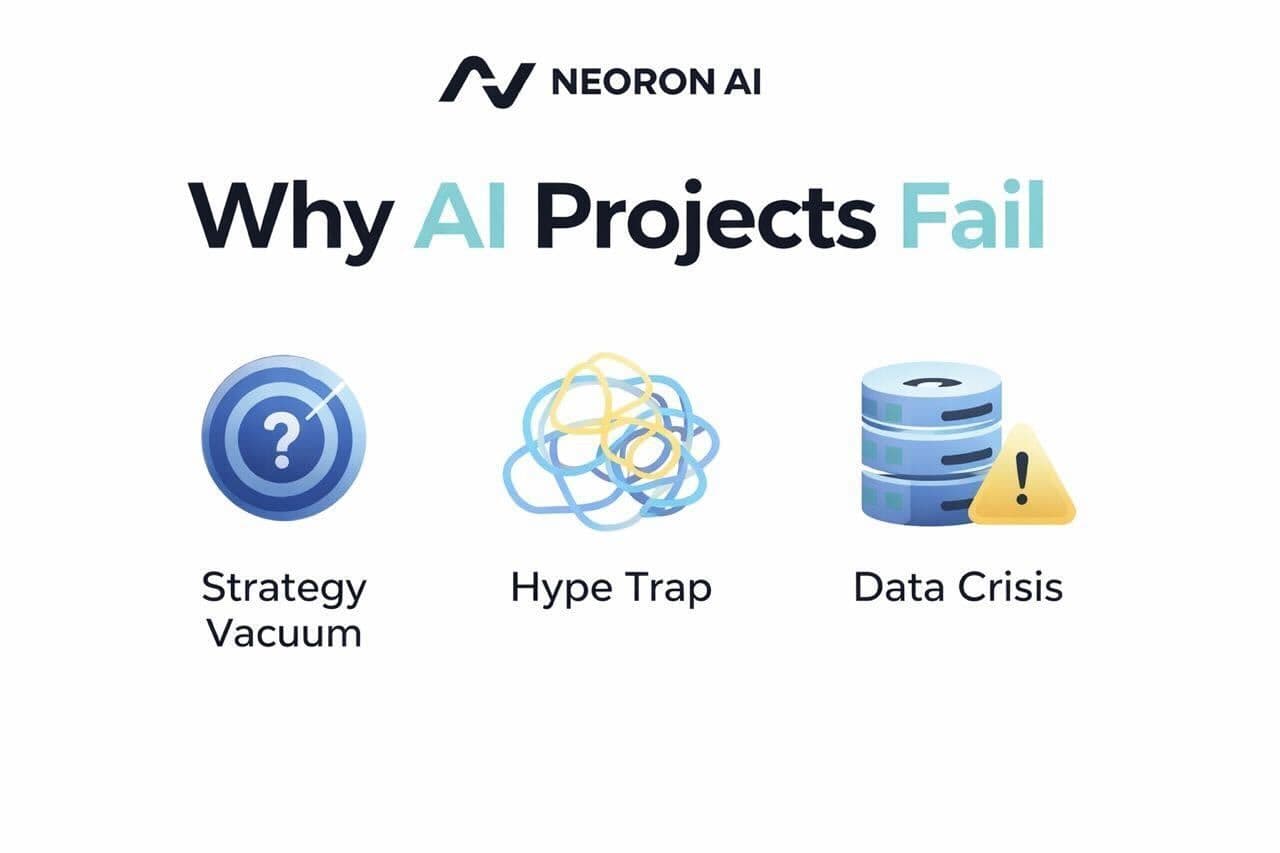
1. The Strategy Vacuum: “AI for AI’s Sake”
The Problem
Many organizations launch AI initiatives driven by competitive pressure or hype cycles rather than clearly defined business outcomes. The result is a landscape of disconnected pilots, unclear priorities, and projects that may be technically impressive but deliver little measurable impact.
The Fix: Problem-First AI Strategy
Start with a clear business objective that is directly aligned with the organization’s top-level strategy. Avoid the trap of building AI tools or running technical benchmarks without a defined business outcome tied to them.
We recommend applying a Value-to-Process (V2P) approach: identify which operational processes to improve based on the value they deliver to customers. Once you have mapped the value chain, three guiding questions sharpen the scope:
- What do customers perceive as “value”? Understand the outcomes your customers actually care about, and work backward to the processes that produce them.
- What costs can be reduced by automating workflows with AI? Target processes with high volume, repetitive patterns, and clear cost structures.
- Which SMART KPIs will demonstrate improvement? Define specific, measurable indicators before the project begins—not after.
2. The Hype Trap: Overpromising AI Capabilities
The Problem
AI is too often positioned as a “magic solution”—a technology that will automatically solve complex problems the moment it is deployed. When expectations are set this high, trust erodes quickly at the first sign of friction, delay, or underperformance.
The Fix: Realistic Milestones, People-First Execution
Set objectives that are aligned with the SMART framework and supported by clear, incremental milestones. AI projects that succeed are rarely the ones with the most ambitious scope—they are the ones with the most disciplined execution.
Critically, the most successful AI transformations are people-first. Technology is only one ingredient. Competent project management, skilled engineers with real domain expertise, and strong functional analysts who understand the business processes are the indispensable elements that turn a promising AI model into a production-grade solution.
3. The Foundation Crisis: Poor Data Quality
The Problem
AI systems are only as effective as the data they rely on. Across the enterprise engagements Neoron AI has supported, fragmented and inconsistent data has been a recurring obstacle—often the single biggest barrier to reaching production.
Common data quality issues include:
- Siloed datasets scattered across business units with no unified access layer.
- Inconsistent formats, naming conventions, and taxonomies.
- Missing, outdated, or duplicate records that corrupt model training and predictions.
The Fix: Invest in Data Readiness First
Data readiness is not a preliminary step—it is the foundation of every enterprise AI project. Before selecting models or architectures, organizations must assess, clean, and consolidate their data estate. The AI is only as strong as what you feed it.
The Four Pillars of AI Project Success
The failure points above converge into a clear framework. Successful AI projects are built on four pillars:
- Strategic Alignment: Every AI initiative must trace directly back to a business objective.
- Measurable Outcomes: Define SMART KPIs before the project starts, not after.
- Realistic Expectations: Set incremental milestones and invest in the right people.
- Strong Data Foundations: Treat data readiness as a prerequisite, not an afterthought.
Organizations that master these pillars do not just “use AI”—they operationalize it as a true competitive advantage.
Final Thought
AI is not just a technology investment. It is a business transformation strategy.
The companies that succeed are not the ones experimenting the most—they are the ones executing with clarity, discipline, and the right partners by their side.
At Neoron AI, we help enterprises move from AI ambition to measurable results. Let’s talk about your AI roadmap.
Prêt à transformer vos processus avec l'IA?
Discutons de vos défis et découvrons comment Neoron AI peut accélérer votre transformation.
Planifier un appel découverte