
AI Misinformation Is Not a Bug It's a Design Flaw. Here's How to Fix It
AI systems generate confident misinformation across politics and business.
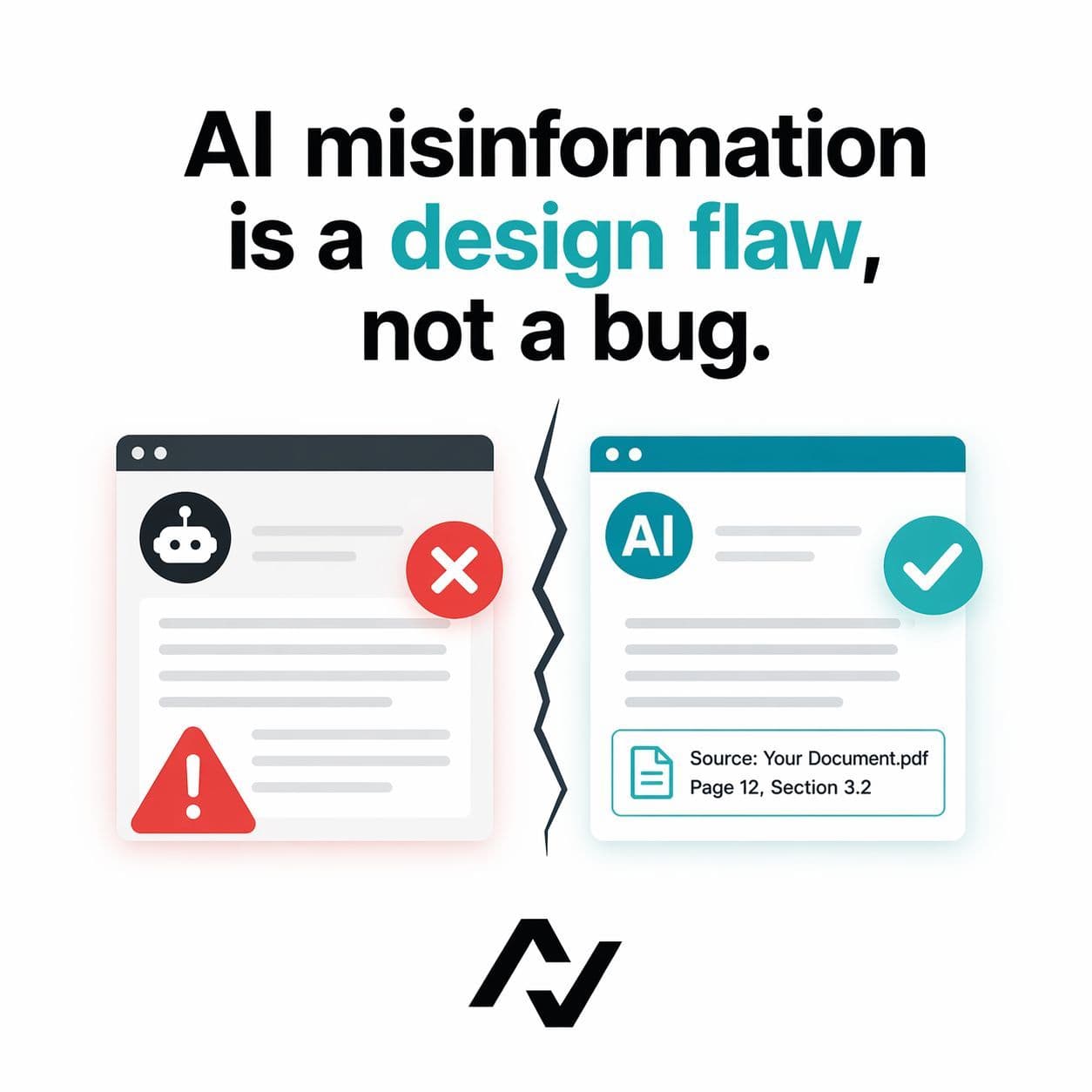
AI misinformation is not a bug. It is a design flaw.
Every day, millions of professionals ask ChatGPT, Google Gemini, and other AI systems questions they expect truthful answers to. Medical practitioners look up drug interactions. Engineers verify compliance standards. Executives make strategic decisions based on AI-generated summaries. And most of the time, the answers sound perfect.
The problem is that sounding perfect and being accurate are two completely different things.
At NEORON AI, we believe the next frontier for artificial intelligence is not generating more content — it is generating trustworthy content. This article explores why AI misinformation happens, where the stakes are highest, and what a fundamentally different architecture looks like.
The root cause: AI does not know truth it predicts patterns
Large language models are trained on vast datasets pulled from news articles, forums, blogs, social media, public documents, and academic papers. These sources are not equally reliable. The internet contains bias, propaganda, outdated claims, and coordinated disinformation campaigns — all mixed together with legitimate information.
AI does not inherently distinguish truth from falsehood. It detects statistical patterns and generates responses that are linguistically coherent. If a misleading narrative appears frequently enough in the training data, the model absorbs and reproduces it with the same confidence as a verified fact.
This is not a failure of the technology. It is a structural limitation of how general-purpose LLMs are designed. And it has consequences across every domain where accuracy matters.
Where the stakes are highest
Politics: amplifying bias at scale
Political topics are among the most vulnerable to AI-generated misinformation. AI systems may reflect or reinforce narratives shaped by state actors, ideological groups, and online echo chambers. On topics like geopolitical conflicts, government characterizations, or contested historical events, a model trained on skewed data will present one dominant perspective while omitting alternatives entirely.
The danger is subtle. AI does not announce its bias it presents information with the same neutral, authoritative tone regardless of whether it is balanced or one-sided. Users perceive this as objectivity, when it may be anything but.
Religion and belief systems: the illusion of final authority
Religion is inherently diverse and interpretive. Different traditions, scholars, and communities hold legitimately different views on the same questions. Yet AI often provides definitive-sounding answers to deeply debated spiritual and theological topics, erasing cultural diversity and minority perspectives in the process.
The risk here is that users treat AI as an authority it was never designed to be. When a model speaks with certainty about matters of belief, it can unintentionally shape personal convictions without the user realizing they are receiving a filtered, incomplete view.
Health and high-stakes decisions: where misinformation costs lives
The consequences are most severe in healthcare. AI is increasingly used for diagnostic support, drug discovery, and genetic research. In some contexts, it influences decisions around treatment prioritization and end-of-life care.
The critical questions become unavoidable: What happens when the model is trained on biased or incomplete clinical data? What happens when it delivers a confident recommendation that turns out to be wrong? And who bears accountability for an AI-driven medical decision?
Unlike political opinions, health misinformation carries direct physical consequences. A wrong answer is not just misleading it can be dangerous.
The four systemic risks
Across all domains, a pattern emerges:
Authority without accountability. AI outputs sound confident even when they are incorrect. There is no built-in mechanism to communicate "I am not sure about this." The model delivers uncertainty and certainty in the same tone.
Scale of impact. A single flawed model can influence millions of users simultaneously. Traditional misinformation spreads person to person AI misinformation spreads at the speed of an API call.
Vulnerability to manipulation. Bad actors can flood the internet with misleading content specifically designed to influence AI training data. This is not theoretical it is already happening.
Erosion of critical thinking. As people rely more heavily on AI for answers, the habit of questioning and verifying information weakens. The convenience of instant answers comes at the cost of intellectual rigor.
The questions we must answer as an industry
The AI industry is at a crossroads. The technology is powerful, adoption is accelerating, and the trust deficit is growing. Several questions demand urgent answers:
How do we detect and filter misinformation in training data before it reaches users? How can AI systems transparently communicate uncertainty and present multiple perspectives? Who regulates AI without stifling innovation? How do we ensure AI systems remain accountable and auditable? And how do we keep these systems aligned with the values of the communities they serve?
These are not purely technical problems. They require collaboration between engineers, policymakers, ethicists, and the public.
A different architecture: what we are building at NEORON AI
At NEORON AI, we chose not to wait for these industry-wide problems to be solved. Instead, we built a product that sidesteps the hallucination problem entirely.
Archimed uses a RAG (Retrieval-Augmented Generation) architecture that fundamentally changes how AI answers questions. Instead of generating responses from a general-purpose model trained on the open internet, Archimed retrieves information exclusively from your own verified documents then generates a response grounded in that specific content.
Every answer includes automatic source citations: the exact document name, page number, and section. If the information is not in your documents, Archimed tells you so rather than fabricating a plausible-sounding answer.
This is not a minor improvement. It is a different paradigm:
- Zero hallucination by design - answers come only from your verified knowledge base
- Full traceability - every response points back to its source
- Data sovereignty - your documents never leave your environment
- Transparent uncertainty - when the system does not know, it says so
For organizations in regulated industries healthcare, finance, government, legal this is not a nice-to-have. It is the minimum standard for responsible AI deployment.
The path forward
AI misinformation is not going away. The models will get better, but the fundamental architecture of general-purpose LLMs means they will always carry some risk of generating plausible-sounding falsehoods.
The choice for organizations is clear: continue using tools that sound confident but cannot be verified, or adopt architectures that are trustworthy by design.
At NEORON AI, we believe the future belongs to AI systems that earn trust through transparency, not through the illusion of certainty.
Prêt à transformer vos processus avec l'IA?
Discutons de vos défis et découvrons comment Neoron AI peut accélérer votre transformation.
Planifier un appel découverte